

THE QUICK ANSWER
What should you know first?
Shut off the fixture or branch supply, then confirm whether the leak is still active before anyone opens the wall. A plumber owns the failed line and any concealed pipe repair; a drying provider owns moisture mapping, extraction, and equipment placement. Treat them as two scopes with two quotes, and ask each one to state what the other must complete first.
Prepare your questions ↓AT A GLANCE
The decisions behind the quote.
Plumber scope
Locate and repair the failed supply line, restore pressure, and confirm the repair holds. Concealed pipe work, fittings, and any required access opening belong here.
Drying scope
Map moisture beyond the visible stain, extract standing water, and place air movement and dehumidification where readings support it. This scope starts after the leak is stopped.
Quote versus final cost
A quote describes the work the provider intends to perform. Ask whether the written price is fixed for a defined scope or an estimate, and how any added work would be approved.
01 / PLAN YOUR CLEANUP
Stop the Source Before You Assess the Cavity
A supply line behind a bathroom wall usually fails at a fitting, a crimp, or a valve connection. Until that source is closed, any cavity assessment is a snapshot of a moving problem. Shut off the fixture valve first; if that does not stop the flow, use the branch or main shutoff. Then confirm the leak is actually stopped by watching the area for a short period before opening anything further.
Electrical safety matters here. Water inside a wall can reach wiring, outlets, or a vanity light circuit. Do not touch switches, outlets, or fixtures in the wet area, and do not stand in standing water while operating electrical equipment. If you are unsure whether electrical parts are wet, keep away from them and contact qualified help. This is a safety boundary, not a reason to delay shutting off the water.
02 / PLAN YOUR CLEANUP
What the Cavity Assessment Actually Looks For
A useful cavity assessment answers three questions: how far moisture traveled, what materials are wet, and whether the wet area crosses into another room or the floor below. The visible stain is only the surface. Water follows framing, insulation, and the path of least resistance, so the wet boundary is often larger than the paint suggests.
- Moisture readings at the stain, at the edges of the stain, and at least one point beyond it
- The back side of the shared wall, if the bathroom wall is not exterior
- The floor below, including a ceiling check if the bathroom is on an upper level
- Cabinets, vanities, and baseboards that may hide wicking
- Insulation condition inside the opened cavity, since some insulation holds water
- Whether the wet zone reaches any electrical box, outlet, or fixture
Document these findings before demolition expands. Photos and readings create a shared reference point for the plumber, the drying provider, and any later conversation about scope. If the assessment shows moisture in a second room, that is a scope change, not a surprise to discover after equipment is placed.
03 / PLAN YOUR CLEANUP
Extraction and Drying Are Not Reconstruction
Extraction removes standing water. Drying reduces moisture in materials that stay in place. Reconstruction replaces material that cannot be dried or that had to be opened for access. These are three different scopes, and a quote that blends them makes comparison difficult.
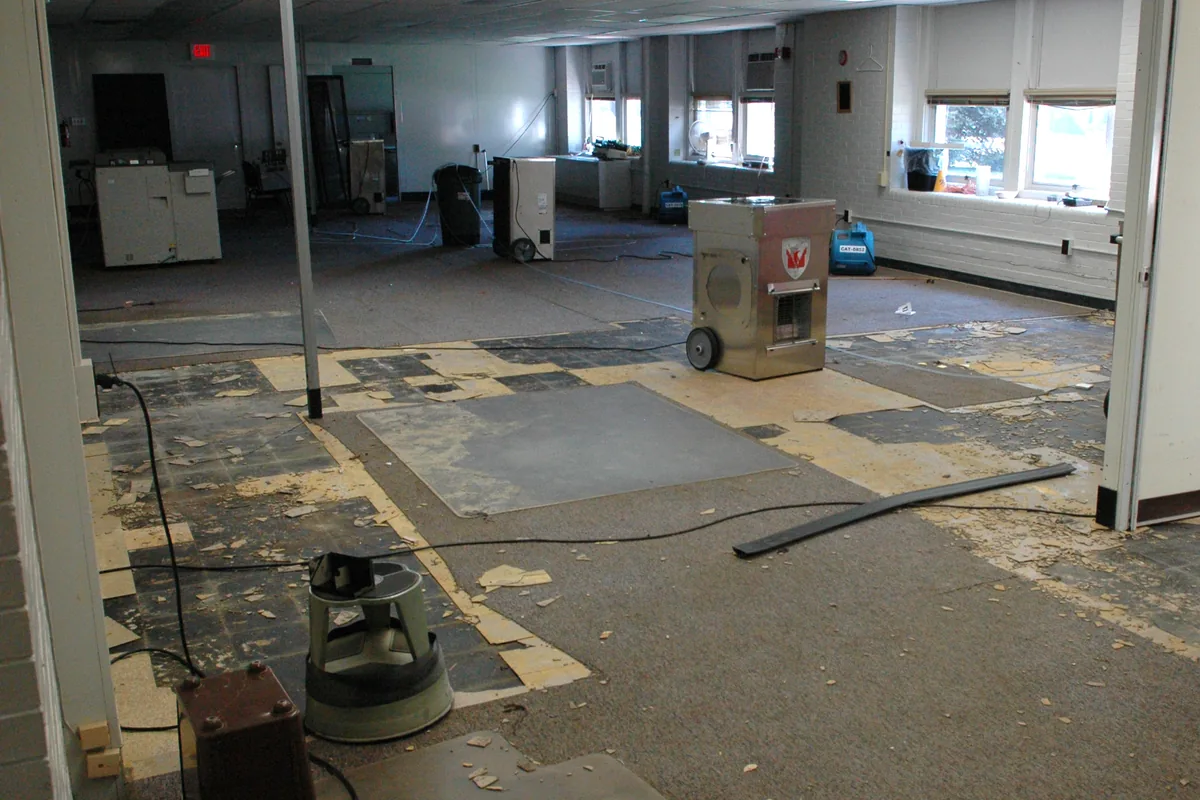
For a wall leak, extraction is often minimal because water is absorbed rather than pooled. Drying may involve air movers and dehumidification aimed into the cavity, with monitoring to confirm readings are falling. Reconstruction covers drywall, tile, paint, and trim after the cavity is dry. Ask each provider to state which of the three they are quoting, and where their scope ends.
04 / PLAN YOUR CLEANUP
The Handoff: What the Plumber Owes the Dryer
The handoff is the point where plumbing repair ends and drying begins. A clean handoff has three parts: the repair is complete, pressure is restored and holding, and the access opening is adequate for air movement. If the plumber closes the wall before drying is finished, the cavity may stay wet behind new material.
- Written confirmation that the failed line is repaired and pressure-tested
- The location and size of the access opening, so drying equipment can be aimed effectively
- A note on any material the plumber removed versus material left in place
- Agreement on who closes the wall and when, after drying readings support closure
If the plumber and the drying provider are separate companies, put the handoff in writing. A short message confirming repair status and access dimensions prevents the common failure where each trade assumes the other finished.
05 / PLAN YOUR CLEANUP
Prepare for the Quote Call
Before calling, gather the facts that change scope: when the leak started, when it was stopped, what is visibly wet, and whether the floor below is affected. Ask each provider what their quote includes, what would change it, and how they document concealed conditions. Avoid accepting a single verbal number that covers both trades without a written breakdown.
- State the fixture and the valve you shut off
- Give the elapsed time between leak discovery and shutoff
- Describe visible wet areas and any adjacent room or floor below
- Ask whether the quote covers repair, drying, or reconstruction
- Ask how additional work is approved if concealed damage appears
- Confirm who returns to verify drying before the wall is closed
For the drying portion, a structured approach helps you compare providers on the same terms. The Structural Drying guide explains how moisture mapping, equipment placement, and monitoring fit together, which is useful when you are deciding what a drying quote should include.
06 / PLAN YOUR CLEANUP
When to Escalate Beyond a Simple Repair
Some wall leaks stay small: one fitting, one cavity, one repair, one dry-out. Others involve a supply line that fed multiple fixtures, a slab or chase, or moisture that reached a second floor. Escalate when the shutoff does not stop the flow, when the wet boundary keeps expanding, or when the cavity contains materials that cannot be dried in place.
Prompt action still matters. Stopping the source, limiting access to wet electrical areas, and documenting conditions are reasonable steps that do not require waiting for a full assessment. The goal is to keep the problem from growing while the two trades are scheduled and their scopes are clarified.
YOUR WRITTEN-SCOPE CHECKLIST
Turn the conversation into clear answers.
Check an item when you understand how it is addressed in the written scope. These checks organize your questions; they do not certify the condition of a property.
CHECK A WRITTEN ESTIMATE
What do the listed charges add up to?
Enter amounts from an estimate you already have. This adds your figures; it does not predict restoration prices. Blank fields count as zero, so confirm missing charges with the provider.
Only the amounts entered are included. Taxes, rebuilding, source repair and changes may be additional.
FREE QUOTE-PREPARATION TOOL
Know what to say when you call.
Build a short description using what you already know. Your notes stay on this page; this does not send a request or book service.
Your call notes
Questions to ask: Confirm the leak is stopped, document the cavity before demolition, and get the plumber's scope in writing before drying equipment is staged. The two scopes should reference each other, not overlap. Do you serve my address? What assessment fees apply, and what is excluded?
Common questions
Should I open the wall before the plumber arrives?
Usually not. A small inspection opening can help, but the plumber may need a specific access point to reach the fitting. Cutting first can remove material the plumber would have used or create an opening in the wrong bay.
Does the drying provider fix the pipe?
No. Drying providers handle moisture, not plumbing repair. The failed supply line must be repaired and pressure-tested by a qualified plumber before drying is meaningful, because a slow weep will re-wet material that was just dried.
How do I compare two quotes for the same wall leak?
Line up the scopes side by side. One quote should cover the plumbing repair; the other should cover moisture mapping, extraction, drying equipment, and monitoring.
What if the wall is shared with a closet or hallway?
Water travels along framing and can wet the opposite side of a shared wall. Ask the drying provider to check the adjacent room with a moisture meter, not just the bathroom side. That check may change where equipment is placed but does not change who repairs the pipe.
YOUR NEXT STEP
A clearer conversation.
A more useful quote.
Have your ZIP code and property details ready. Confirm address coverage, fees and the proposed scope before booking.
Call for Quote · (833) 628-1561 ↗Houston Water Recovery connects callers with independent providers. Availability, qualifications, work and pricing are confirmed by the provider.
Sources & further reading
This guide explains public guidance and questions to ask. It is not a property assessment or a documented customer case, and no technician review is claimed.
CDC: Electrical hazards after flooding ↗EPA: Flooded homes cleanup guidance ↗