

THE QUICK ANSWER
What should you know first?
Before a water cleanup call, note what flooring you have, any known installation details, the visible wet area, and when water appeared. These observations help the provider ask better questions; they cannot establish whether a floor can dry in place or must be removed. Ask how the provider will assess the layers beneath the surface, what is included in extraction and drying, and whether later floor repairs are part of the quote. If water is still entering, address the source promptly when safe, and avoid wet electrical equipment.
Prepare your questions ↓AT A GLANCE
The decisions behind the quote.
Product
Note whether the floor is carpet, sheet vinyl, luxury vinyl plank or tile, ceramic or stone tile, hardwood, engineered wood, laminate, or concrete. Product family narrows the likely cleanup approach.
Installation
Note whether it is glued down, floating, nailed or stapled, thinset-set, or stretched over tack strip. Installation can affect access to wet layers and whether a section can be lifted without damage; ask how the provider will check.
Scope split
Separate the source repair from the cleanup. A failed supply line, appliance drain, or exterior opening may need a plumber, appliance technician, or exterior trade before or alongside cleanup.
01 / UNDERSTAND THE PROCESS
Start with the product, not the puddle
Two rooms can look equally wet and still need different cleanup scopes. A glued-down vinyl plank and a floating laminate may both be covered in water, but the installation method can affect how a provider assesses the layers underneath. Identifying the product and installation before you call gives the provider a head start and helps you ask better questions about scope.
02 / UNDERSTAND THE PROCESS
Quick product and installation worksheet
Use the following prompts to build a short note for your call. You do not need to know brand names or technical terms. Describe what you see and how the floor behaves underfoot.
- Product: carpet, sheet vinyl, luxury vinyl plank or tile, ceramic or stone tile, hardwood, engineered wood, laminate, or concrete.
- Surface: smooth, textured, wood grain, grout lines, seams, or tack strip visible at the edge.
- Installation clue: glued down, floating, nailed or stapled, thinset-set, or stretched over pad.
- Underfoot feel: soft, spongy, hollow, loose, firm, or crunchy.
- Edge behavior: does the floor lift at the wall, or is it fixed under baseboard or trim?
- Wet area: roughly how many square feet, and is water still entering?
- Timing: when did you first notice it, and was there recent plumbing or flooring work?
03 / UNDERSTAND THE PROCESS
What each product family usually means for scope
The notes below are general planning aids, not a diagnosis. A qualified provider still needs to assess the floor, the subfloor, and nearby materials. Use them to frame questions, not to rule anything in or out.
- Carpet and pad: extraction and drying are common cleanup steps, but pad often cannot be dried in place and may need removal. Carpet itself may be saved or replaced depending on the water source and how long it was wet.
- Sheet vinyl and glued-down vinyl: water can trap under the sheet or in the adhesive layer. Drying may require special attention at seams and edges, and removal may be needed if water is trapped underneath.
- Floating luxury vinyl plank or tile: water can move through the joints and sit on the subfloor. Ask whether inspection shows water below the planks and what selective access or removal would involve.
- Ceramic or stone tile: the tile itself is often more water-resistant than the setting bed or subfloor. Cleanup may focus on the grout, setting bed, and subfloor, and tile removal may be needed to reach wet layers.
- Hardwood and engineered wood: these materials can cup, crown, or swell when wet. Drying may be possible in some cases, but refinishing or replacement may be part of reconstruction.
- Laminate: many laminate cores swell when wet and may not return to a usable flat surface. Ask whether the material can be dried and retained or whether replacement is justified; separate cleanup from reconstruction in the scope.
- Concrete: concrete can hold moisture and release it slowly. Cleanup may focus on drying the slab surface and managing nearby materials, with reconstruction tied to coatings or floor coverings.
04 / UNDERSTAND THE PROCESS
Source repair is not the same as cleanup
A wet floor is often a symptom. The source might be a supply line, drain, appliance, exterior opening, or a slow leak behind a wall. Source repair stops water from entering again. Cleanup removes water and dries materials. Reconstruction restores what cannot be dried or saved. These are separate scopes, and a single quote may not cover all three. Ask who is responsible for each part before work begins.
05 / UNDERSTAND THE PROCESS
Extraction and drying versus reconstruction
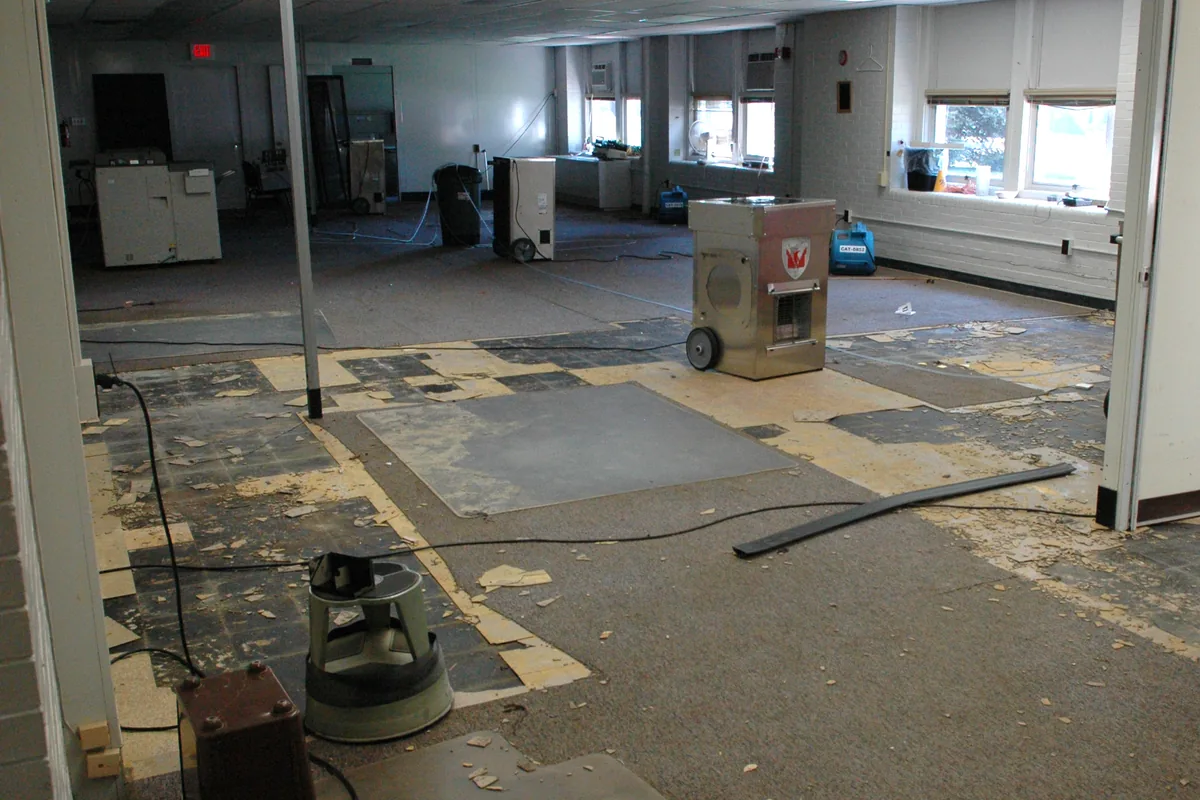
Extraction removes standing water. Drying removes moisture from materials that stay in place. Reconstruction replaces materials that cannot be dried or that were removed to allow drying. For example, extracting water from a carpeted room is cleanup. Removing and replacing the pad and reinstalling carpet is reconstruction. Lifting floating plank to dry the subfloor may be cleanup or reconstruction depending on who does it and what gets replaced. Ask the provider to label each line item.
06 / UNDERSTAND THE PROCESS
Quote scope versus final cost
Ask whether the written price is fixed for a defined scope or is an estimate. Hidden conditions, such as a wet subfloor, may call for a revised scope and a documented approval before additional work. That does not mean the quote is meaningless. It means you should ask what is included, what is excluded, and how changes are approved. A clear scope comparison helps you avoid surprises.
- Ask what the quote includes: extraction, drying equipment, monitoring, removal, disposal, and reconstruction.
- Ask what is excluded: source repair, subfloor repair, trim, baseboard, paint, and flooring replacement.
- Ask how additional work is approved and documented if hidden moisture or damage is found.
- Ask whether drying equipment placement and monitoring visits are part of the quoted scope.
- Ask for the scope in writing before authorizing work.
07 / UNDERSTAND THE PROCESS
Prepare for the call without delaying safe action
If water is still entering and you can stop it safely, do so. Avoid electrical hazards: do not stand in water near outlets, cords, or appliances, and do not touch electrical equipment in a wet area. If you are unsure, keep people away and contact qualified help. Reasonable mitigation, such as moving valuables away from the wet area and documenting conditions, can continue while you prepare your notes. For drying context, see the Structural Drying guide.
08 / UNDERSTAND THE PROCESS
A short script for the call
Lead with the facts you recorded. For example: The floor is floating luxury vinyl plank in a 12 by 14 room. Water came from a supply line under the sink and is now shut off. The floor feels spongy near the wall, and I can see water at the seams. I have photos and a rough wet-area measurement. I need cleanup and drying, and I need to know whether the floor has to come up and whether reconstruction is separate. That gives the provider enough to ask useful follow-up questions.
09 / UNDERSTAND THE PROCESS
What to avoid while you wait
- Do not pull up flooring unless a qualified professional advises it.
- Do not use household fans or shop vacuums in standing water near electrical equipment.
- Do not assume the floor is dry because the surface feels dry.
- Do not sign a scope that does not separate cleanup, source repair, and reconstruction.
- Do not delay reasonable mitigation if water is still entering and it is safe to stop it.
10 / UNDERSTAND THE PROCESS
Bottom line
Identifying the flooring product and installation before you call turns a vague cleanup request into a specific scope conversation. It helps you separate source repair from cleanup, extraction and drying from reconstruction, and quote scope from final cost. Use the worksheet, keep safety first, and ask for the scope in writing.
YOUR WRITTEN-SCOPE CHECKLIST
Turn the conversation into clear answers.
Check an item when you understand how it is addressed in the written scope. These checks organize your questions; they do not certify the condition of a property.
CHECK A WRITTEN ESTIMATE
What do the listed charges add up to?
Enter amounts from an estimate you already have. This adds your figures; it does not predict restoration prices. Blank fields count as zero, so confirm missing charges with the provider.
Only the amounts entered are included. Taxes, rebuilding, source repair and changes may be additional.
FREE QUOTE-PREPARATION TOOL
Know what to say when you call.
Build a short description using what you already know. Your notes stay on this page; this does not send a request or book service.
Your call notes
Questions to ask: Product and installation help frame the inspection. Ask what evidence supports drying in place or selective removal, and whether repairs are included. Do you serve my address? What assessment fees apply, and what is excluded?
Common questions
Why does flooring type change the cleanup call?
The product and installation help a provider assess whether drying equipment can reach wet layers. Carpet over pad, floating plank, glued-down vinyl, and thinset tile each dry differently. Ask what inspection findings would support drying in place or removal, and how each option affects the written scope.
What is the difference between extraction and drying?
Extraction removes standing water and much of the water held in porous materials. Drying uses air movement and dehumidification to remove moisture that remains in the floor, pad, subfloor, or nearby walls. Both are cleanup steps, not reconstruction.
When does reconstruction enter the conversation?
Reconstruction enters when cleanup cannot restore the floor to a usable condition. Examples include saturated carpet pad that cannot be saved, swollen laminate or engineered wood, or tile that must be removed to dry the subfloor. Ask the provider to separate cleanup scope from reconstruction scope in writing.
Should I pull up wet flooring before the call?
Do not pull up flooring unless a qualified professional tells you to. Lifting some materials can release trapped water, damage the subfloor, or expose hazards. Instead, stop the water source if it is safe to do so, keep people away from electrical hazards, and document what you see.
YOUR NEXT STEP
A clearer conversation.
A more useful quote.
Have your ZIP code and property details ready. Confirm address coverage, fees and the proposed scope before booking.
Call for Quote · (833) 628-1561 ↗Houston Water Recovery connects callers with independent providers. Availability, qualifications, work and pricing are confirmed by the provider.
Sources & further reading
This guide explains public guidance and questions to ask. It is not a property assessment or a documented customer case, and no technician review is claimed.
CDC: Electrical hazards after flooding ↗EPA: Flooded homes cleanup guidance ↗